Use Windows Explorer's search features to search for a specific item by its name.
As mentioned earlier, within the Safe Share folder:
All items that you own are located inside the My Secured Files subfolder.
All items owned by other people who have shared these items with you as a collaborator are located inside the Shared With Me subfolder. Within this folder, items are grouped into subfolders based on the owners who shared these items with you. The names of these subfolders contain the email addresses of their owners and are based on the format: Shared By <local-part-of-email-address> - <domain-part-of-email-address>
To search for items that you have shared with other people:
On the left of the main Safe Share page, click Sharing to filter for all items that you have shared with other people.
From this page, you can perform any of the following Safe Share web application functions:
Open the 'Share' dialog box on an item to modify the item's collaborators and/or their permissions. Tip: You can also modify the permissions of existing collaborators on the item or remove existing collaborators from the item (without having to open this Share dialog box) via the Sharing and Permissions section of the Details tab to the right of the currently selected item.
To help organize your files in storage (managed by the Covata Platform), in the Safe Share folder, you can create folders within the My Secured Files subfolder, which also facilitates the ability to share multiple items of your securely stored content with a group of people. (You can also create folders within the Shared With Me subfolder, assuming you have the appropriate permissions to do so.)
These folders can be created using Windows Explorer's New > Folder feature and added to either:
The My Secured Files subfolder for organizing your own content and also sharing it with groups of people.
A subfolder within the Shared By ... folder (of the Shared With Me subfolder), if the subfolder's owner granted you Manage permissions as a collaborator on this subfolder.
Unsharing secure content
'Unsharing' an item that you own effectively removes all or specific collaborators from the item and its contents, so that only you as the owner of this item can control who can access it.
Using Safe Share's Unshare feature on a folder removes all collaborators from not only this folder, but also all collaborators from every item contained within this folder (which had been set explicitly on these items). For more information about explicit versus implicit sharing, refer to the main Note towards the end of the step on selecting permissions for a collaborator (of the Sharing secure content procedure).
To unshare your securely stored content:
Access the Safe Share folder (for your/the required organization).
Within the My Secured Files subfolder, locate to the file or folder to unshare.
Do one of the following to begin unsharing this item:
To remove all collaborators from a file or folder (including every item contained within this folder):
Right-click on the item and choose Safe Share > Unshare from the pop-up menu.
Click OK on the confirmation message box to complete the change.
Alternatively,
Right-click on the item and choose Safe Share > Share from the pop-up menu.
In the resulting Safe Share dialog box, click the Unshare button towards the lower left left.
Click OK on the confirmation message box to complete the change. (Be aware that the item is unshared immediately and there is no need to click the Save button on the Safe Share dialog box.)
If the item was a folder, all collaborators from every item contained within this folder are removed.
To remove specific collaborators from a file or folder:
Right-click on the item and choose Safe Share > Share from the pop-up menu.
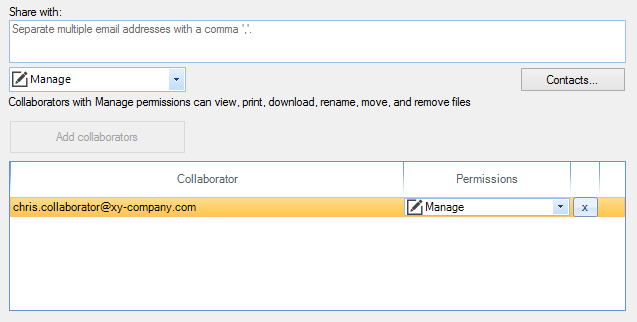
In the resulting Safe Share dialog box, click the x button associated with the collaborators to remove them from this item.
Click the Save button to complete the change.
If the item was a folder, only the specific collaborators whose x buttons were clicked are removed from this folder. Any collaborators set explicitly on any other items contained within this folder remain unaltered.
Renaming an item
An item can be renamed if:
you own the item or
a Covata user has shared the item with you (as a collaborator) with Manage permissions on the item.
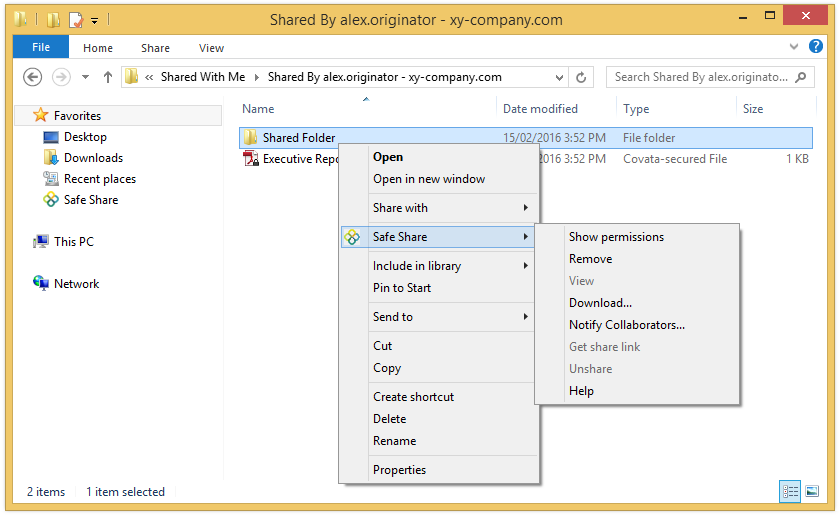
Locate the item within the My Secured Files or Shared With Me subfolders to rename. Note: If you intend to rename an item within a subfolder of Shared With Me, then the item's owner must have granted you the Managepermission set (which in turn grants you the individual rename permission) on the item. You can determine this by right-clicking the item and choosing Safe Share > Show permissions from the resulting pop-up menu:
Use Windows Explorer's file/folder renaming features to rename the item. Notes:
Unlike the Safe Share web application, Safe Share for Windows permits changes to file name extensions. Be aware, however that changes to the file name extension of a viewable file may result in the file no longer being able to open in the read-only content viewer (including the content viewers of any other Safe Share application).
It may take some minutes for this change to be visible to all collaborators.
If you are renaming an item within the Shared With Me folder and you receive the following message 'You do not have permission to rename this item', then the owner of this item did not grant you Manage permissions when they shared the item (or its parent folder) with you. Important: An issue in this version of Safe Share for Windows results in a Windows Rename message box appearing with the message 'The file or folder does not exist.' Ignore this message box and close it by clicking its OK button.
Removing personally owned content
Removing personally owned secure content which you or a collaborator had previously stored/uploaded (using any Safe Share application), both:
Removes this content from storage managed by the Covata Platform and also
Prevents other people you have shared this content with from being able to access it.
Within the My Secured Files subfolder, locate the personally owned file or folder (which you or a collaborator had previously stored/uploaded) to be removed.
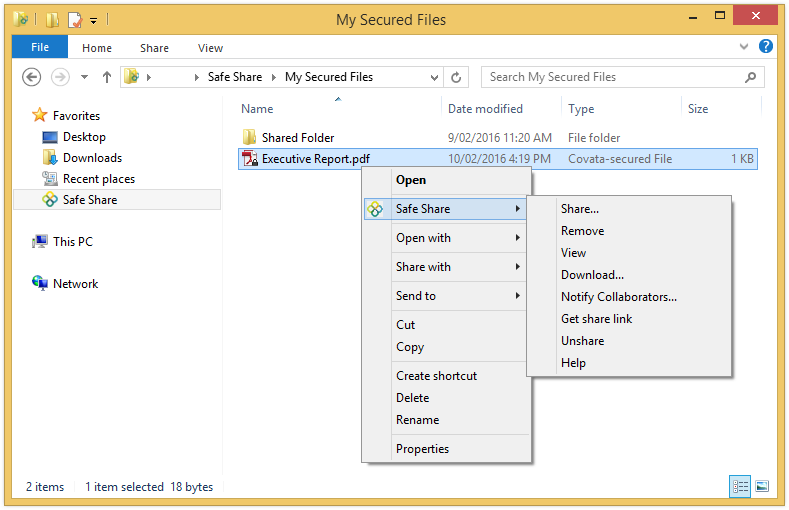
Right-click on the item (i.e. either a file or a folder) and choose Safe Share > Remove from the pop-up menu:
Safe Share for Windows prompts you to confirm this removal and upon clicking Yes, your item and its content is removed from storage. Any people you shared this item's content with will no longer be able to access the item.
Removing content shared through another user's folder
Within the relevant Shared By ... folder of the Shared With Me subfolder, locate the file (which you or someone else had previously uploaded to another user's folder) or subfolder (created inside that other user's folder) to be removed. Note: To determine if you have the Remove permission on this item (which is required to remove the item and its content from storage), right-click the item and choose Show permissions from the pop-up menu. If you do not have this permission, proceeding with the next step instead will only remove your access to this item and its content. For more information about showing permissions on an item, see the procedure on determining if you have permissions to upload content to another user's folder.
Right-click on the item and choose Safe Delete from the pop-up menu.
Safe Share for Windows prompts you to confirm this removal and upon clicking Yes, the item and its content is removed from storage. Any people who had access to this item's content will no longer have access to it.
Removing your access to secure content (shared with you)
Removing your access to secure content which someone else had shared with you (through any Safe Share application):
Removes this content from your list of items only.
Is similar to the owner of this content removing you as a collaborator from it (see Unsharing secure content above for more information).
Note: The owner of this content (and anyone else they have shared it with) can still access this content from storage managed by the Covata Platform.
To remove secure content which you or someone else had uploaded to another user's folder through any Safe Share application:
Within the relevant Shared By ... folder of the Shared With Me subfolder, locate the file or folder (which you or someone else had previously shared with you using Safe Share for Windows or the web application) from which to remove your access. Note: If you have the Remove permission on this item, which you can determine by right-clicking the item and choosing Show permissions from the pop-up menu, then proceeding with the next step will instead remove this item and its content from storage. For more information about showing permissions on an item, see the procedure on determining if you have permissions to upload content to another user's folder.
Right-click on the item and choose Safe Delete from the pop-up menu.
Safe Share for Windows prompts you to confirm this removal and upon clicking Yes, your access to this item is removed, which also removes the item from within the relevant Shared By ... folder.