To access secure content, you can:
Viewing/printing/downloading your own content
To view/print/download/decrypt content which you have previously stored securely:
- Access the
Safe Share folder for your organization.
- Within the
My Secured Files subfolder, locate to the file/s or folder/s whose content you wish to view/print/download/decrypt.
- Do one of the following based on the action to be performed:
- To begin viewing/printing your own secure content, either:
-
For a single viewable file, double-click it to open Safe Share for Windows' read-only content viewer window (i.e. the Safe Share Content Viewer).
Note: If the file you double-clicked is not viewable, a message is shown indicating that the file's type is not supported by the Safe Share Content Viewer. File types which are supported are equivalent to those in the Safe Share web application's content viewer. See File formats supported by the content viewer in the Safe Share User's Guide for the web application for more information.
OR
-
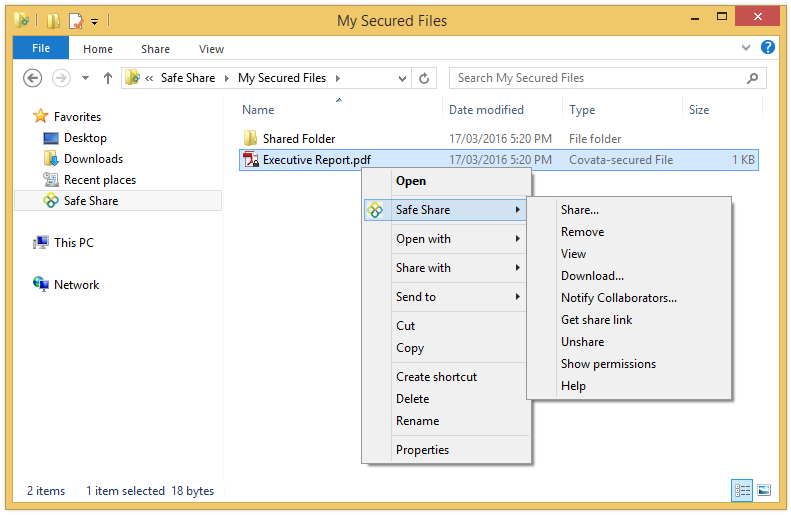
For one or more file/s, select and right-click on the file/s and choose Safe Share > View. A separate Safe Share Content Viewer window opens for each viewable file of your selected content.
Notes:
-
If one of the files you selected is not viewable, a message is shown indicating that the file's type is not supported by the Safe Share Content Viewer. File types which are supported are equivalent to those in the Safe Share web application's content viewer.
-
The View menu item is disabled if the selected items only consist of folders and/or non-viewable files. Although this menu option is available if one or more folders have been selected in addition to viewable files, any content within these folders is ignored (and not opened in the Safe Share Content Viewer).
- To begin downloading/decrypting your own secure content, either:
-
Select the item/s and drag/copy/move them to a location outside the
Safe Share folder; for example, dragging them to your desktop:
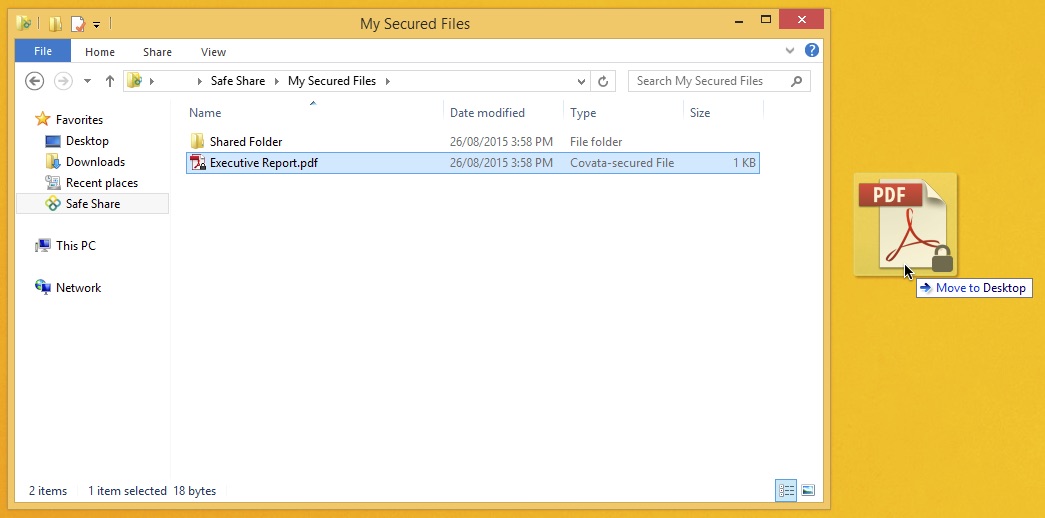
Note: Regardless of whether you copy or move items from My Secured Files, the secured items will remain in the My Secured Files subfolder.
OR
-
Alternatively, select and right-click on one or more file/s and/or folder/s and choose Safe Share > Download from the pop-up menu:
The Browse For Folder dialog box opens, prompting you to specify a location where your selected content will be download.
Safe Share for Windows downloads/saves the content (decrypting it on your computer) at the target location (e.g. your desktop).
Note: If the Safe Share for Windows cache policy settings are active and the files you are downloading are already cached locally on your computer (i.e. with .cov file extensions), then Safe Share for Windows only decrypts these files from locally cached content (as opposed to downloading the content first).
Viewing/printing/downloading content (shared with you)
If files have been shared with you, then your ability to view and/or print + download/decrypt these files is based on the permissions that were granted to you as a collaborator on these files. The content viewer is useful when the owner of a file (or a collaborator with Manage permissions on it) wants to share the file's content but not allow the content to be printed and downloaded.
To view/print/download/decrypt secure content which someone else has securely shared with you:
- Access the
Safe Share folder for your organization.
- Within the
Shared With Me subfolder, identify/locate the folder of the Covata user who shared content with you.
Note: You can only download/decrypt a file within these types of folders if you were granted Download permissions (or greater permissions that grant the individual download permission) when the file (or one of its ancestral folders) was shared with you. If you do not have the individual download permission on a file, then you can only view its content.
- Within this other user's
Shared By ... folder, locate the file/s or folder/s whose content you wish to view/print/download/decrypt.
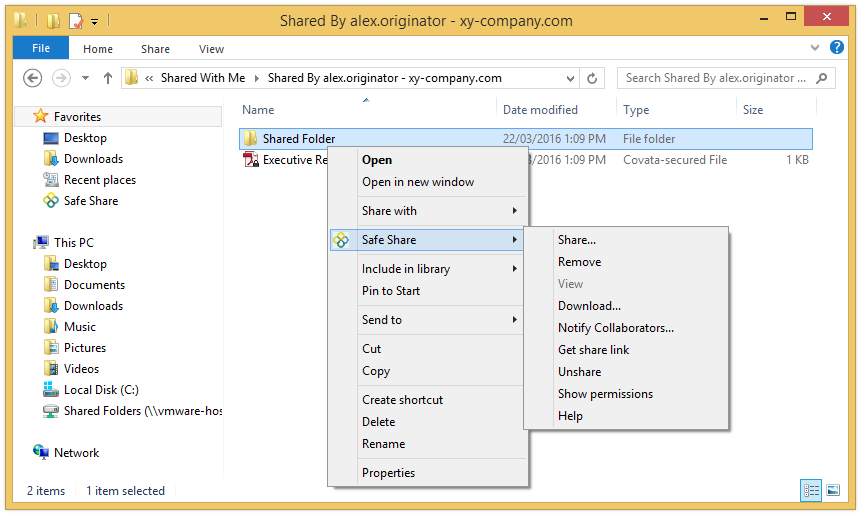
Note: To determine if you can view or print the content of a file or folder (i.e. by having the individual view or print permissions respectively on the item), right-click the item and choose Safe Share > Show permissions from the pop-up menu:
- Do one of the following based on the action to be performed:
- To begin viewing/printing secure content which someone else has securely shared with you, either:
-
For a single viewable file, double-click it to open Safe Share for Windows' read-only content viewer window (i.e. the Safe Share Content Viewer).
Note: If the file you double-clicked is not viewable, a message is shown indicating that the file's type is not supported by the Safe Share Content Viewer. File types which are supported are equivalent to those in the Safe Share web application's content viewer. See File formats supported by the content viewer in the Safe Share User's Guide for the web application for more information.
OR
-
For one or more file/s, select and right-click on these file/s and choose Safe Share > View. A separate Safe Share Content Viewer window opens for each viewable item of your selected content.
Notes:
-
If one of the files you selected is not viewable, a message is shown indicating that the file's type is not supported by the Safe Share Content Viewer. File types which are supported are equivalent to those in the Safe Share web application's content viewer.
-
The View menu item is disabled if the selected item/s only consist of folders and/or non-viewable files. Although this menu option is available if one or more folders have been selected in addition to viewable files, any content within these folders is ignored (and not opened in the Safe Share Content Viewer).
- To begin downloading/decrypting secure content which someone else has securely shared with you, either:
-
Select the item/s and drag/copy/move them to a location outside the
Safe Share folder - e.g. dragging them to your desktop:
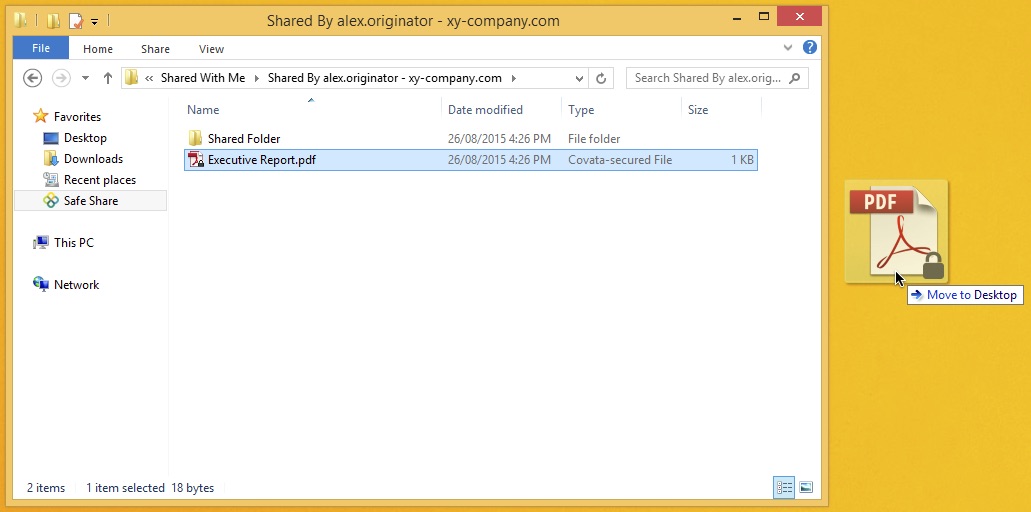
Note: Regardless of whether you copy or move items from Shared With Me, the secured items will remain in the Shared With Me subfolder.
OR
-
Alternatively, select and right-click on one or more file/s and/or folder/s and choose a Safe Share > Download option from the pop-up menu:
The Browse For Folder dialog box opens, prompting you to specify a location where your selected content will be download.
Safe Share for Windows downloads/saves the content (decrypting it on your computer) at the target location (e.g. your desktop).
Notes:
- If you downloaded a folder, either by dragging/copying/moving the folder to a location outside the
Safe Share folder (or via the Safe Share > Download right-click option), then all files within the folder (including its subfolders) are downloaded/decrypted, with the exception of subfolders on which you only have View permissions. If such a subfolder were to contain its own folder on which you had the individual download permission, then you would need to download this subfolder in a separate action.
- If the Safe Share for Windows cache policy settings are active and the files you are downloading are already cached locally on your computer (i.e. with
.cov file extensions), then Safe Share for Windows only decrypts these files from locally cached content (as opposed to downloading the content from remote storage first).
- If files were moved out of any
Safe Share folder to a network drive location, then these files will only reappear in the source Safe Share folder following a subsequent Safe Share for Windows synchronization event (with remote storage managed by the Covata Platform). Regardless of the Safe Share folder's cache policy settings, these files will always reappear as .covl files and their encrypted content will only be downloaded the next time the files are decrypted (using Safe Share for Windows).
- If Safe Share for Windows experiences delays in network communication, you may notice the following behavior:
- The encrypted files are temporarily copied to their target location.
- Safe Share for Windows decrypts these files from their temporary copies (created in the previous step) and saves them to the same location as their temporary copies.
- The temporary copies are deleted.
Safe Share for Windows' read-only content viewer
Safe Share for Windows' read-only content viewer (also known as the Safe Share Content Viewer within the application) and the content viewer of the Safe Share web application are equivalent features.
The Safe Share Content Viewer opens when you view your own or someone else's file with Safe Share for Windows.
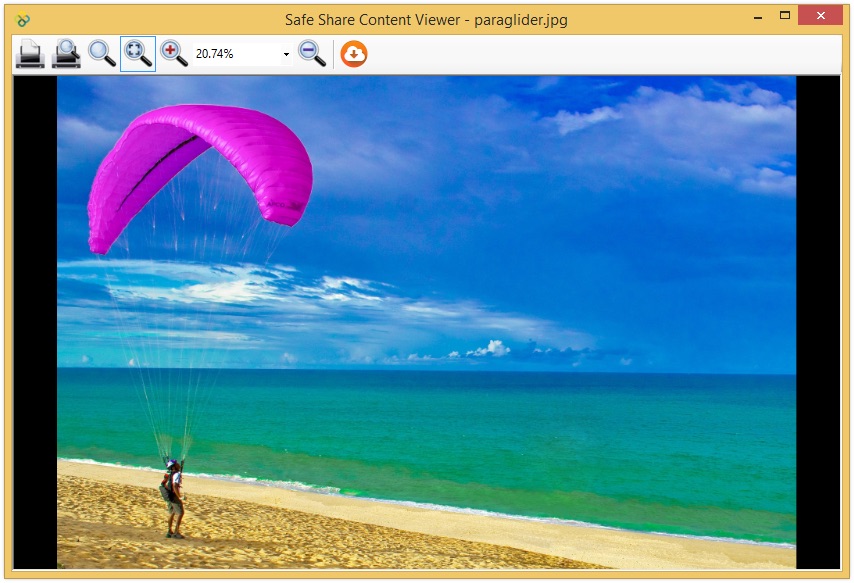
Safe Share for Windows' content viewer for image files:
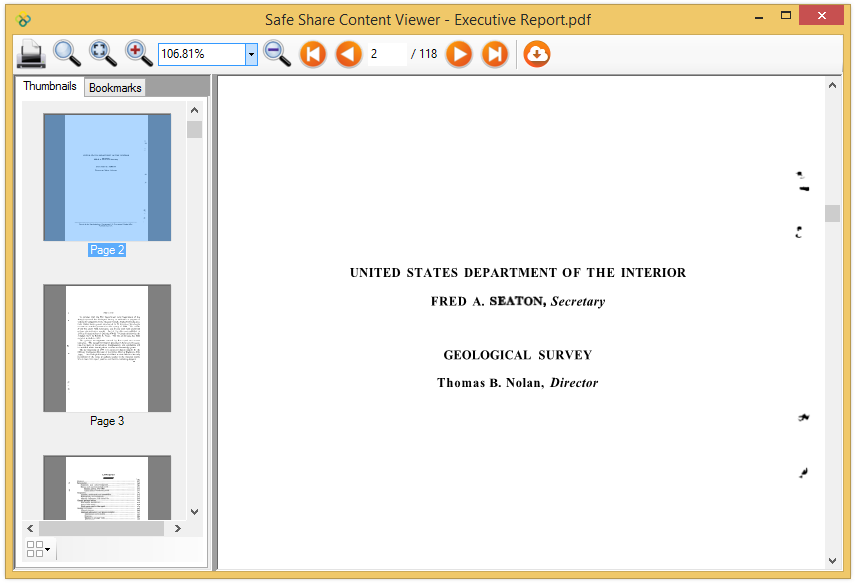
Safe Share for Windows' content viewer for document files:
Tips on using the Safe Share Content Viewer:
- Click the 'Print' icon
to print the file's content.
Note: This icon will not be available if you are a collaborator on the file being viewed (see Sharing secure content) and you were only granted View permissions on the file, which does not grant the individual print permission that allows you to print it directly from the content viewer.
- If you are viewing an image file, click the 'Print preview' icon
to view a preview of the file's content (before printing it).
Notes:
- Like the 'Print' icon, this icon will also not be available if you are a collaborator on the file being viewed and you were only granted View permissions.
- The print preview feature has its own functional icons for printing and zooming.
- Print previews can only be generated in portrait orientation. Landscape-oriented previews are not available through this feature.
- Click the 'Actual size'
and 'Fit to viewer'
icons zoom to the native size of the content or the size that fits the viewer, respectively.
- Click the 'Zoom In'
and 'Zoom Out'
icons to zoom in and out of the content view, respectively. The adjacent drop-down can also be used to select an appropriate zoom level.
- Click the 'Download' icon
on the content viewer to download the content of a file (belonging to you or someone else).
Note: This icon will not be available if you are a collaborator on the file being viewed and you were only granted View permissions on the file, which does not grant the individual download permission that allows you to download the file's content.
- If you are the owner of the file you are currently viewing, click the 'Share' icon
to open the 'Share' dialog box, which allows you to add new collaborators and/or modify existing collaborators (including their permissions) on this file.
Note: This icon will also be available if you are a collaborator on the file being viewed and you were granted Manage permissions on the file (which grants the individual share permission).
- If your content consists of multiple pages, you can navigate to different pages by:
- Clicking the 'Next Page'
and 'Previous Page'
icons to respectively move forward and back one page at a time.
- Clicking the 'First Page'
and 'Last Page'
icons to respectively jump/go to the first and last pages of content.
- Typing a page number in the 'Current Page' field (followed by the 'return/enter' key).