 |
SafeShare Administrator's Guide

|
|
SafeShare Administrator's Guide
|
The features of SafeShare Administration are only available to SafeShare administrators, where a SafeShare administrator is any Covata user who has the SafeShare administrator role.
When signing in to SafeShare Administration, a Covata user account must have the SafeShare administrator role to access all SafeShare Administration features of the Covata Platform * .
Note: If accessing SafeShare Administration for the first time, see Accessing SafeShare Administration for the first time (below) before continuing.
To sign in to SafeShare Administration:
/#/admin) in your browser's URL field - e.g: https://covata-platform.xy-company.com/#/admin * Additional notes:
- Any Covata user (including any SafeShare administrator) whose account has the Organisation administrator role for a given organisation can manage and administer that organisation. For more information about the Organisation administrator role, see Administering users within an organisation in the SafeShare Organisation Administration section of this guide.
- A SafeShare administrator (typically a Covata user account with only the SafeShare administrator role) can grant themselves the Organisation administrator role for an organisation by making themselves the administrator of this organisation when they add/create the organisation. This user (who now has both the SafeShare administrator role and the Organisation administrator role for this organisation) can then grant other Covata users the Organisation administrator role for their organisation. Otherwise (and perhaps more typically), a SafeShare administrator cannot administer an organisation added to their Covata Platform instance, unless the Organisation administrator initially set for this organisation (or someone else that this person subsequently made an Organisation administrator of their organisation) grants the SafeShare administrator the Organisation administrator role for their organisation (i.e. when adding the SafeShare administrator to the organisation).
The SafeShare Administration interface consists of a set of configuration pages, each of which is accessible from the options on the left (below). Note that:
The Dashboard page is initially displayed upon a SafeShare administrator successfully signing in to SafeShare Administration (above).
Note: If accessing SafeShare Administration from a tablet or phone, tap the 'menu' icon in the top left hand corner of the screen to access these options.
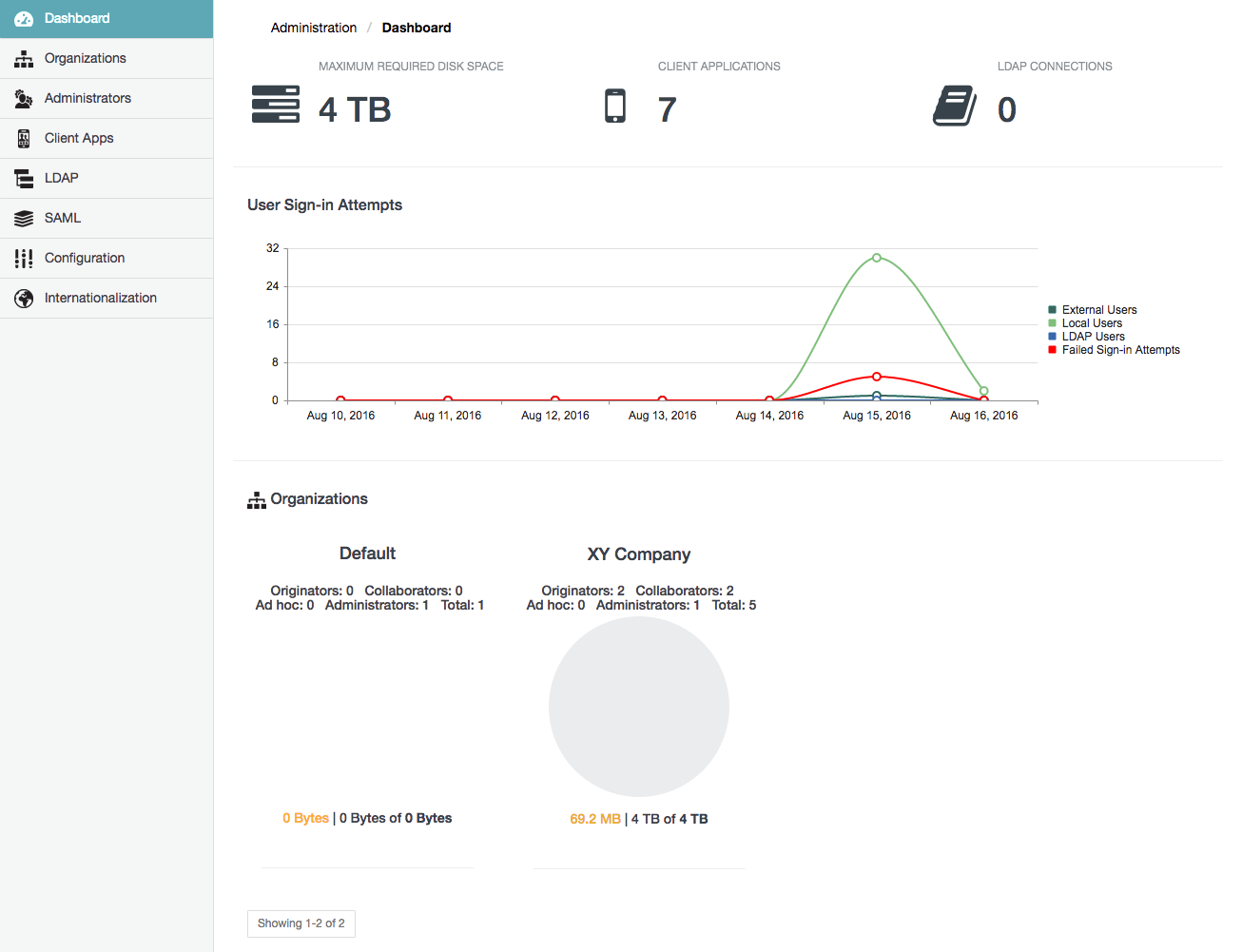
The table below describes each of these SafeShare Administration pages, which can be accessed by clicking its option on the left of the interface.
| SafeShare Administration page | Description |
|---|---|
| Dashboard | Provides a single-page graphical overview of various aspects of your Covata Platform's current statuses (presented in panels), recent sign-in attempts (presented in graph form) as well as system usage metrics for each organisation including Covata user account roles and storage usage/availability. |
| Organisations | Allows SafeShare administrator-level access to all organisations configured on your Covata Platform instance. From this page, any SafeShare administrator can:
|
| Administrators | Allows access to all Covata users who are SafeShare administrators, from which any SafeShare administrator can:
|
| Client Apps | Allows the registration and configuration of applications (e.g. built by integrators using the Covata Platform's API) which uses Covata technologies to create and/or access files (also known as file objects or Secure Objects). The configurations of these 'client' applications on the Covata Platform define:
|
| LDAP | Allows the configuration of connections to one or more LDAP user directories, which can be used to populate the Covata Platform with Covata user accounts. |
| SAML | Allows the configuration of a SAML-based Identity Provider (IdP) service to which Covata users can authenticate to gain access to the Covata Platform and SafeShare for Web through single sign-on. |
| Configuration | Allows the modification of properties that affect certain functional areas across the Covata Platform (including all organisations configured on it). |
| Internationalisation | Allows custom/external language bundles to be uploaded to provide the Covata Platform with greater internationalisation support for more languages. Also allows SafeShare administrators to change the user interface language for the sign-in page, as well as the default language of SafeShare Administration, SafeShare Organisation Administration and (initially) SafeShare for Web for any newly added Covata users. |
The Dashboard page is initially displayed upon a SafeShare administrator successfully signing in to SafeShare Administration.
The following table describes each component of the Dashboard page from left to right/top to bottom.
| Dashboard page component | Description |
|---|---|
| Maximum Required Disk Space | This panel shows the total amount of storage space that the Covata Platform (managed through the Content Service) requires to store content for all Covata users with the Originator role (i.e. who have a plan) across all of the Covata Platform's configured organisations. Clicking this panel opens the Organisations page. Notes:
|
| Client Applications | This panel shows the total number of client applications currently registered on the Covata Platform. Clicking this panel opens the Client Applications page. |
| LDAP Connections | This panel shows the total number of LDAP connections currently configured on the Covata Platform. Clicking this panel opens the LDAP Connections page. |
| User Sign-in Attempts | This graph shows Covata user sign-in attempts over the past week, with each point along a curve representing activity pertinent to that curve on a given day. Each curve on the graph represents the number of successful sign-in attempts from one of the three types of Covata user account (discussed in more detail in Administering users within an organisation, of this guide's SafeShare Organisation Administration section). The fourth curve represents the total number of failed sign-in attempts. |
| Organisations | This section of the dashboard shows each organisation configured on the Covata Platform. For each of these organisations, the following information is indicated:
|
To sign out of SafeShare Administration:
Important: Please ensure that you explicitly sign out of SafeShare Administration using this procedure. If you simply close the browser tab or window that contained your SafeShare Administration session, then you will not be signed out, leading to the risk that your session may be compromised by someone else subsequently using your computer.
New Covata Platform instances have a default administrator user account (with email address admin@default.com).
This user account exists for the purpose of:
Important: For security reasons:
- After the
admin@default.comaccount is used to create your new SafeShare administrator account/s, then use one of these new accounts to remove theadmin@default.comaccount from SafeShare Administration.- If the
admin@default.comaccount was used to add an Organisation administrator account to the initially-named Default organisation (described in Editing an existing organisation and Adding an organisation user account), then use this Organisation administrator account to remove theadmin@default.comaccount from Organisation Administration.
To access a new Covata Platform instance and initially set up SafeShare Administration users:
/#/admin) into your browser's URL field - e.g: https://covata-platform.xy-company.com/#/adminadmin@default.com and password admin@default.com user account (from SafeShare Administration).